Updated versions and eight language translations launched November 2020
Our hugely popular infographics, parent brochures and personalized inserts have all been updated to be language based rather than country based.每个下载包括三个版本使用相同的语言反映不同的区域:A4大小,删除阿托品的A4和字母大小。
我们目前对英语,西班牙,法语和罗马尼亚语的翻译崭新的更新以反映有关近视控制功效的最新科学研究和临床消息传递。我们添加了DIMS技术奇观镜头,被Hoya商业化为Miyosmart;并根据最近发表的BLINK Study。
 We've also changed the imagery to children on bicycles, with the 'single vision wearing' bicycle child without a helmet to protect him from rushing towards high myopia. You'll notice the helmets become more robust as the 'protection' offered by myopia control options increases in efficacy.
 我们添加了四个新的翻译 - 希伯来语,阿拉伯语,简化中文和传统中文。
- Download themHERE
- Watch our explanatory YouTube videoHERE
- 链接并分享我们为父母的解释性视频,以从我们的mykidsvision.or188足彩比分直播g for Mykidsvision.org加强您的解释。这里。
Further reading and references are provided below. You can also read the history of the Managing Myopia Guidelines Infographics from their first launch in late 2019.
Four versions released in January 2020
To celebrate the launch of the brand new Global Myopia Symposium, we provided hundreds of free copies of this infographic at the Global Specialty Lens Symposium in Las Vegas. These were co-branded again with the Centre for Ocular Research and Education (CORE), University of Waterloo, Canada. This North American version is the same as that provided at AAO as noted below.
2020年1月,我们推出了四个版本,以说明世界各地的可用治疗选择,近视管理策略和默认打印页面大小的差异。他们是澳大利亚/新西兰,北美,英国和英国 - 原子氨酸的去除。如上所述,在2020年11月,我们使用了较新的科学数据,并反映了语言使用而不是国家使用。

First version released in October 2019
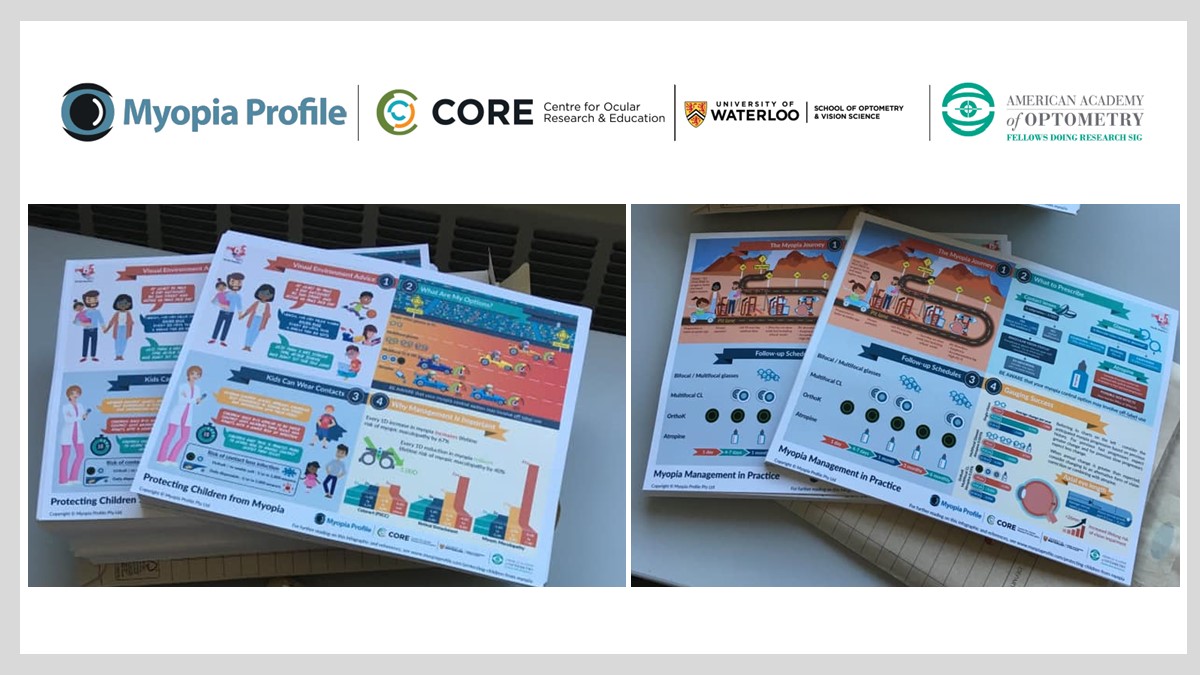
我们开发了这个世界第一,临床关注infographic for the American Academy of Optometry (AAO) meeting in Orlando, Florida in late October 2019. In collaboration with the Centre for Ocular Research and Education (CORE), University of Waterloo, Canada - who printed them, big thanks! - and the AAO Fellows Doing Research Special Interest Group (FDR SIG), we distributed these in the Exhibit Hall. If you've got one of these myopia management infographics in your hand, hot off the press, and are looking for the scientific basis of the information in front of you, you'll find this below. It is designed to support your clinical communication with parents (Side 1) as well as provide a reference for practitioner knowledge in clinical myopia management (Side 2).
Side 1 - Protecting Children from Myopia,,,,is the parent-facing side to help you with clinical communication:
1️⃣视觉环境建议 - 对所有前毛皮前和近视的孩子都很重要(以及任何孩子!)
2️⃣我有什么选择?赛车类比解释近视控制功效
3️⃣Kids Can Wear Contacts - the benefits of CL wear for kids and the simple message about safety
4️⃣Why Management is Important - understanding the risks of myopia and benefits of myopia control for lifelong eye health.
这里有三个关键的基于证据的消息。
Firstly that at least 90 minutes a day spent outdoors appears to delay onset, and while there is conjecture, may also help slow progression of myopia. To read more about this, check out our blogWhy Outdoor Time Matters in Myopia Development。
其次,更近的工作距离(小于20厘米),更长的工作持续时间(连续45分钟以上)与近视相关。阅读研究here。The 20/20 rule is a simple way to explain that regular breaks can benefit both visual stamina and refractive development - every 20 minutes take a break for 20 seconds and look across the room.
Finally, the recommendation for no more than 2 hours of screen time per day, at least 60 minutes of physical activity per day and not sitting for too long come from the recommendations of the美国儿科学会和Australian Government Department of Health。
侧2-实践中的近视管理,以实践者为面的功能以供我们的临床参考:
1️⃣The Myopia Journey - risk factors for faster progression
2️⃣开处方 - 基于我们的临床决策树和网站上可用信息图的简化流程图
3️⃣Follow-up Schedules - a reference from the IMI Clinical Management Guidelines
4️⃣衡量成功 - 如何根据折射和轴向长度来判断您的治疗是否长期工作。
该瓷砖解释了导致童年近视的更快发展的因素。首先,早期发作(9岁之前)可能会导致更快的进展和高近视风险。然后以“近视汽车”的“燃料”燃料的其他因素,没有特别的作用顺序,包括近视的家族史;每天不到60-90分钟在户外度过;放学后每天超过2-3个小时,在近工作上度过;和特定的双眼视力障碍。您可以阅读有关这些信息的更多信息,并在我们的博客中查看科学参考Assessing Risk of Myopia Onset and Progression。
凯特·吉福德(Kate Gifford为近视踩踏准备您的练习。
One sided version in Optometry Australia Pharma magazine, September 2019
澳大利亚验光量季度专业杂志Pharma已发布了2019年9月的特殊近视功能问题 - 链接到完整的PDFHERE。与OA结合使用,我们开发了此信息图,以与BHVI近视管理指南并存。该信息图可供澳大利亚验光的所有成员使用 - 使用您的Pharma副本发布了一份硬拷贝。
BHVI指南具有近视的标准眼科检查,发作和进展的危险因素,可用治疗列表以及跟进时间表。我们的目的是通过以下四个关键原则在实践信息图中使用我们的近视管理来填补临床实践的差距。下面对信息图的每个部分以及对进一步阅读的引用的描述如下。
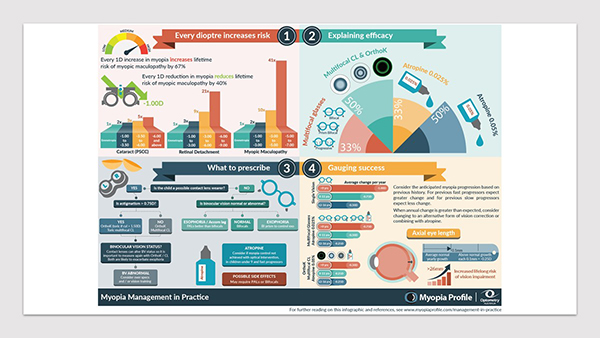
This section is a clear picture of the 'why' of myopia control. The odds ratios of increasing risk of pathology with increasing myopia - where '1' is the risk for an emmetrope - are presented, to help you have this conversation with parents and patients. To read more on this, check out our blog onThe 'Why' of Myopia Control。
Every dioptre matters - right across the range of myopia, anew data analysis published recently by Mark Bullimore and Noel Brennanhas shown that from 1D to 2D; from 2D to 3D; even from 6D to 7D there is an equally escalating risk of myopic maculopathy of 67%. This is serious stuff! So when we control myopia, reducing progression by 1D in total reduces risk of myopic macuopathy by 40%. This is another clear and important message for our patients and their parents.
如果您想了解更多信息,请在我们免费的新在线课程中获得指导性的学习经验Myopia Management in Practice。